
Description
The Coin
Alexander the Great (336-323 BC)
Silver Drachm.
Obv: Head of Herakles.
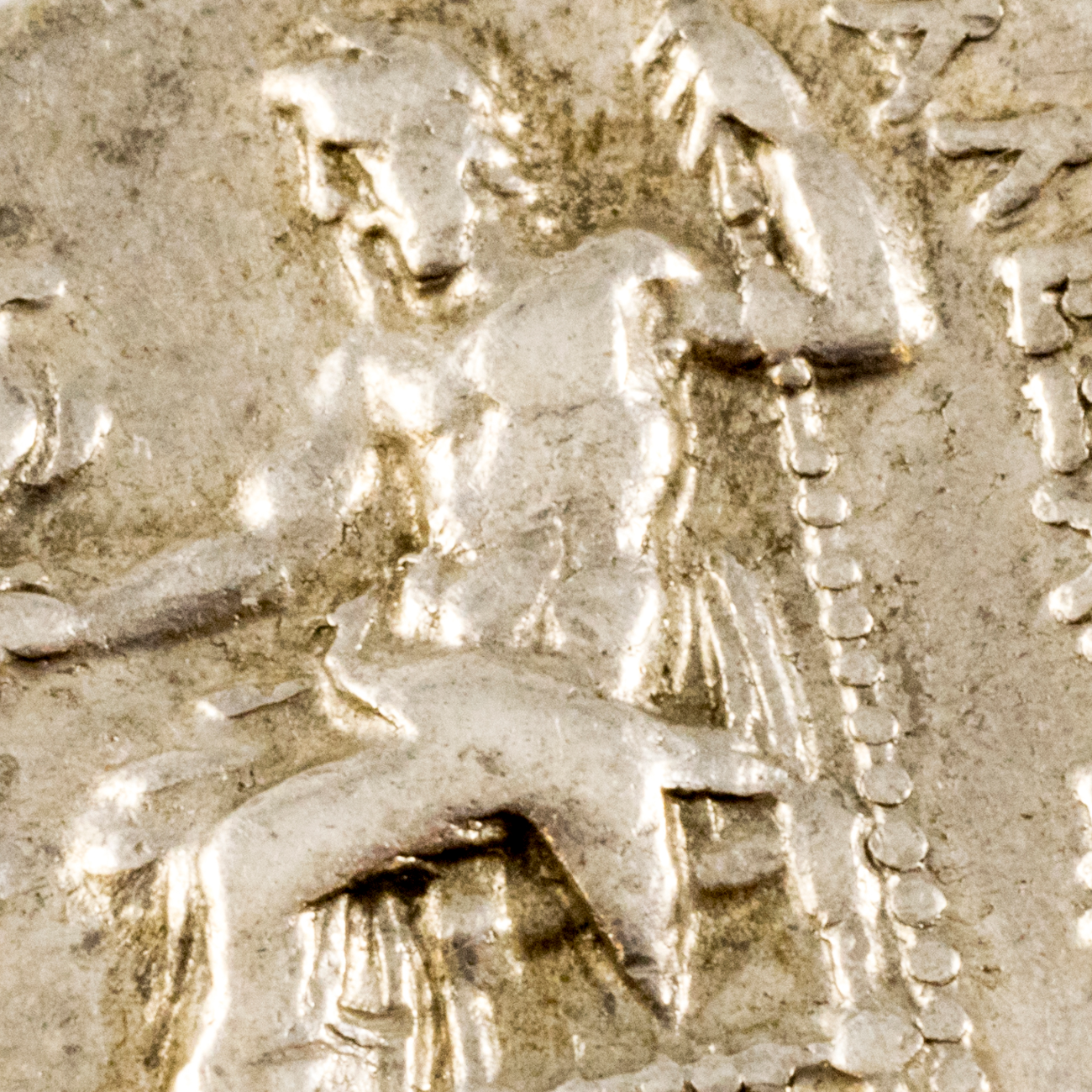
Rev: Zeus enthroned holding eagle and scepter.
Alexander the Great
Alexander the Great, the ruler of Macedonia from 336 to 323 BC, is widely regarded as one of the greatest military commanders in history, going undefeated in battle on his miraculous journey across Asia and Africa. This coin is a silver drachma coin made during the Alexander the Great Age of 336-323 BC (worth about 19 cents in modern day currency). On the obverse of the coin is a portrait of Alexander the Great as Hercules wearing the Nemean Lion Skin, and on the reverse Zeus is enthroned holding an eagle and his sceptre. The reverse of the coin also has “Alexander” inscribed on it. Herakles, the son of Zeus, was a mortal who became divine by performing 12 difficult tasks, one of which was slaying the Nemean Lion, and thus Herakles is known for wearing the skin of the Nemean Lion which Alexander is depicted with. The slaying of the Nemean Lion was one of these 12 tasks. There are conflicting opinions on the meaning of this image. Many historians believe it shows Alexander’s desire to become a God after being born mortal like Herakles. Miletus and Lampascus (both in Modern-day Greece) controlled the producing of silver drachmas in Alexander’s empire, so this coin likely originated in either of these two locations. In the years following Alexander’s death, many coins were still used across his kingdom for the payment of soldiers and for tributes. As Rome became a world power, Greek influence continued to diminish, and by the middle of the 2nd century ancient Alexander Coins were essentially abandoned, but continued to be imitated throughout history.
Assessing the Value of a Drachma
It is difficult to estimate comparative exchange rates with modern currency because the range of products produced by economies of centuries gone by were different from today, which makes purchasing power parity (PPP) calculations very difficult; however, some classical historians and economists have estimated that in the 5th century BC a drachma had a rough value of 25 U.S. dollars (in the year 1990 – equivalent to 46.50 USD in 2015[8]), whereas classical historians regularly say that in the heyday of ancient Greece (the fifth and fourth centuries) the daily wage for a skilled worker or a hoplite[9] was one drachma, and for a heliast (juror) half a drachma since 425 BC.[10]
Modern commentators derived from Xenophon[11] that half a drachma per day (360 days per year) would provide “a comfortable subsistence” for “the poor citizens” (for the head of a household in 355 BC). Earlier in 422 BC, we also see in Aristophanes (Wasps, line 300–302) that the daily half-drachma of a juror is just enough for the daily subsistence of a family of three.
A modern person might think of one drachma as the rough equivalent of a skilled worker daily pay in the place where they live, which could be as low as $1 USD, or as high as $100 USD, depending on the country.

Original Collection at Belmont Hill School